


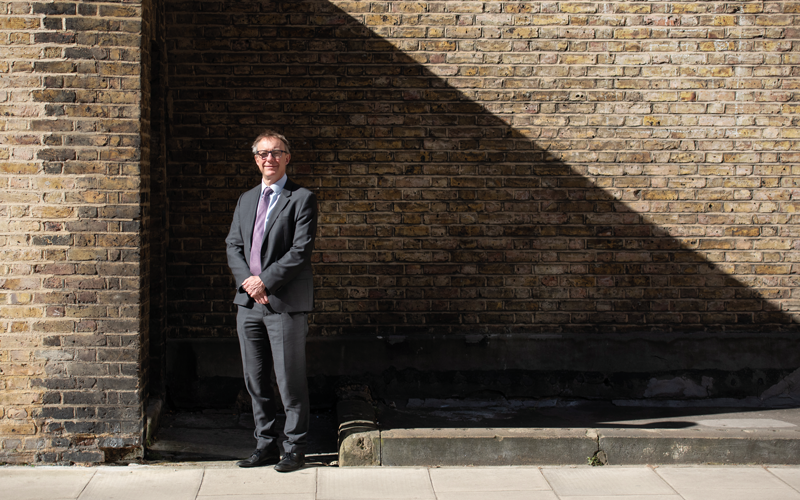
You have to squint a bit, but Paul Johnson’s 14-year stint as the UK’s fiscal-commentator-in-chief pretty much coincides with the birth and evolution of the Office for Budget Responsibility.
Maybe it’s fitting that the OBR is facing some questions on its role and the overall usefulness and accuracy of its forecasts just as Johnson prepares to step down as director of the Institute for Fiscal Studies.
Back in 2011 when Johnson joined the IFS, the OBR was still a fledgling institution, the brainchild of then-chancellor George Osborne, with a remit to put some independent rigour and scrutiny into the long-run view of the public finances and dispel accusations that they were subject to political meddling.
Some even raised the question that the OBR was going to start eating the IFS’s lunch. Johnson has always been resistant to these suggestions — they are different organisations doing different things, and under Johnson’s leadership the institute has found fresh frontiers to probe as well as continuing to issue must-read analysis of the UK’s core fiscal position. And, of course, Johnson is able to apply the IFS’s famed scrutiny to the OBR itself.
In his fourth and final interview with PF ahead of his departure from the IFS this summer — his deputy, Helen Miller, has been announced as the new director (see panel) — Johnson reflects on the OBR’s impact.
Overall, the OBR has been a positive, he tells PF, putting more valuable information into the public domain and injecting some useful transparency into fiscal forecasts. But Johnson argues that it finds itself in an “increasingly awkward” position, with its judgments taking on an absurd level of importance.
“Now [the OBR has] been put in a really difficult position, with chancellors continually running right up against their fiscal rules. And, remember, it’s the chancellor who sets the fiscal rules. The OBR has no say in that. All they do is assess whether chancellors are meeting their own rules,” he says.
“But because [chancellors] keep running so close to them, tiny changes to OBR judgments can make the difference as to whether chancellors are free to carry on or have to suddenly start increasing taxes or cutting spending.”
This was borne out at the spring statement on 26 March as Rachel Reeves delivered a fresh round of spending cuts to restore exactly the very small amount of fiscal headroom (£9.9bn) she gave herself at last year’s Budget. On television, post-statement, Johnson commented that it looked as if the OBR tail was wagging the Treasury dog.
It was a remark typical of Johnson’s straight talking and often witty turn of phrase. The famed independence of the IFS gives him a platform to speak truth to power, and it is a privilege he takes seriously.

An Augustinian approach
Our interview takes place on the same afternoon that work and pensions secretary Liz Kendall announces a radical package of welfare changes in the House of Commons.
Such is Johnson’s grasp of government spending that he’s able to give PF a highly informed read-out and some instant reaction. “A more substantive set of changes than we’d appreciated,” is the verdict.
While the fallout from the announcement is already proving politically difficult, Johnson is hard-headed. The number of people moving onto disability benefits and claiming personal independence payments has ballooned.
“There is obviously a big problem. The extent to which this spending has gone up in the past few years – and is expected to go up – is pretty extraordinary. We’ve got tens of billions of pounds of additional spending [on these benefits], compared with where we were pre-Covid. I don’t think anyone can sensibly look at what’s happened and think everything’s fine.”
The IFS, of course, has the luxury of not having to worry about the politics, and its clear-eyed commentary often runs up against governments determined to cling on to popular but, many would argue, perverse policies. For example, Reeves’ decision to remove winter fuel payments from all but the poorest pensioners was, says Johnson, sensible — he calls the policy a “political gimmick”. But making a standalone announcement rather than bundling it in a wider package of Budget measures may have backfired, he says.
Johnson has some sympathy for the chancellor’s “genuinely tough” fiscal inheritance. The outgoing Conservative government left her “implausibly tight” spending plans, having cut taxes in a way that was “never going to be sustainable”.
But he is critical of the lack of a plan to deal with it and what he calls Reeves’ “Augustinian” approach to last year’s Budget, raising taxes, spending and borrowing with a promise to be more prudent in five years’ time.
“[The chancellor is saying] let’s be nice now and let’s promise to be virtuous in the future. But let’s see whether they really are.”
Same as it ever was?
Johnson can be surprisingly acerbic in his pronouncements on politicians’ failure to take tough decisions. He despairs at what he sees as the failure of both main parties to properly address the funding of social care. Health and social care secretary Wes Streeting’s decision to task Baroness Louise Casey with leading yet another independent review, which will not issue final recommendations until 2028, is just further evidence of kicking the can down the road, and for Johnson, a far more meaningful decision than scrapping the winter fuel allowance.
“I find it deeply depressing. We’ve been in this position [with social care] for decades and decades, and have had review after review, but because it doesn’t have any political salience, because most people most of the time aren’t thinking about it, [politicians] just get away with it.”
Tax is another area where Johnson has been a staunch critic of the complexity of the system and the lack of a clear plan to modernise a centuries-old system made worse by the addition of complex new taxes: “There’s no strategy – there’s no sense of direction even – within a parliament, within a party, even within a chancellor. It really does look like each Budget is done completely independently of the previous one, rather than as a long-term view.”
He also highlights the “astonishing” size of the tax take. “For most of my life, tax has been wiggling around 33% of national income, and, then, over the past six years, it’s suddenly gone up by another 5% of national income… this is a big change.”
When it comes to fiscal devolution, Johnson is cautiously in favour of allowing some taxes to be localised, although he offers the caveat that the UK, while very centralised, is also very unequal. “As soon as you start allowing more tax devolution, you immediately make places more unequal in terms of what they’ve got to spend.” However, he believes that devolving gradually and to the correct scale will be a good thing for economic performance over the long run.

Global crisis as benchmark
Johnson seems slightly surprised when it’s pointed out that Reeves is the eighth chancellor whose policies he and his team have scrutinised. He counts off her predecessors just to make sure, adding the observation that we’ve also had seven chancellors in the past eight years.
This is indicative of a period of intense volatility, characterised by unforeseen events and deep shocks – from Brexit and Covid to the cost-of living crisis and Donald Trump’s attempts to rewire the international order.
For Johnson, the original shock was the global financial crisis, the effects of which still have not fully dissipated, he says.
“You can date the slowdown in productivity growth, the slowdown in earnings growth, the slowdown in economic growth to then. No one expected interest rates to stay at zero for as long as they did. Then, once they’d been there for eight or nine years, everyone thought they’d stay there forever.”
But, of course, they didn’t. “Things have changed in ways that really weren’t predicted, and possibly weren’t predictable, [and] have had fundamental effects on the economy and the public finances and the way we think about them.”
The high cost of debt interest, in particular, consumes a huge portion of the public finances, he says. “We are spending a fortune on the interest – way over £100bn pounds every year.”
On some of the other shocks, Johnson gives brisk verdicts. Brexit “appears to have slowed us down a bit”, he says, highlighting the lack of pre-referendum preparation for life outside the EU. The impact of the pandemic, however, is still hard to determine.
“We know it added a lot to debt, but is the economy on a different path to the path it would have been on had we not had Covid? I don’t know. I don’t think anyone knows.”
An expanding IFS
It has been an interesting period to have been director of the IFS, he agrees with a laugh – certainly more so than in earlier years, when everything was going so well.
There have been few major external signs of the IFS changing under Johnson’s tenure. The organisation continues to occupy modest offices on a quiet Bloomsbury street, not far from the British Museum, and the workforce remains largely office-based. Johnson took a call when furlough ended in 2021 to get the team back to the office on a four-day-a-week basis.
“This is a young organisation where we hire people straight out of university, and if they’re not in the office, working with people, they’re not going to learn anything,” he says.
“The culture here is so important, and you don’t drive a culture if people aren’t in.”
The organisation has grown slightly under Johnson’s leadership. It has a more stable senior team, improved finances, and has extended and deepened its work into some new areas, including health, devolved government, local government and justice.
“We’ve got absolutely brilliant geniuses working here,” says Johnson. “We recruit brilliant people. We train them really well. There must be 10 or 11 people here who were here when I started 14 years ago. It’s a small organisation, so we keep really good people, and people who leave have gone to great things.”
Leaving the IFS will be “quite a wrench” he admits, but he is looking forward to starting a new job and new life as provost of Queen’s College, Oxford – a role he will take up in time for the start of the next academic year. Being in a new intellectual environment, mixing with the students and learning the workings of a much more ancient institution (Queen’s College was founded in 1341; the IFS in 1969) are all challenges he is looking forward to grappling with.
“Much as I love the economics of public policy, there are other things in the world,” he laughs.
What words of advice does he have for his successor?
“Keep up the good work! Protect the culture, protect the independence, carry on supporting and growing the great people here, and don’t be afraid to say it as it is.”
The IFS, Johnson says, is a wonderful place. “I think it really is quite unique in how we try to play this genuinely independent role.”
Looking back on 14 years, what stands out for him is the impact the organisation makes and the power of its voice: “I mean this may sound silly, but what we say kind of matters.”
It certainly does.
Passing the reins
Helen Miller, deputy director at the IFS since 2019, will succeed Paul Johnson as IFS director.
Miller has been at the IFS since 2007, becoming its head of tax in 2016 and deputy director three years later. Johnson has praised Miller’s energy, insight and commitment to the IFS’s mission and culture.
“I am sure the IFS will only go from strength to strength under her leadership, continuing to produce analysis of the highest quality, to hold government to account and, perhaps most importantly, to develop new generations of great economists, communicators and leaders,” he said.
For Miller, her appointment is a “huge privilege and a delight”.
“The IFS is full of inspirational people who are working to ensure that policymakers, and those who hold them accountable, better understand the effects of different economic policy choices,” she said.
“This mission – and the need for truly independent and rigorous analysis – is as important as ever.”
Back in time
Paul Johnson is unique in PF history as a four-time interviewee
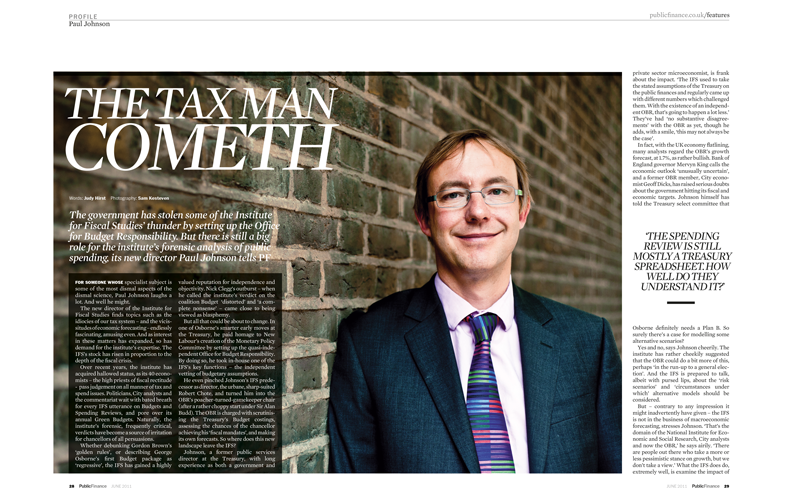
June 2011
‘The tax man cometh’
How the new OBR might influence the work of the IFS; the likelihood of an impending income squeeze –and his aim to expand the span of IFS activities.
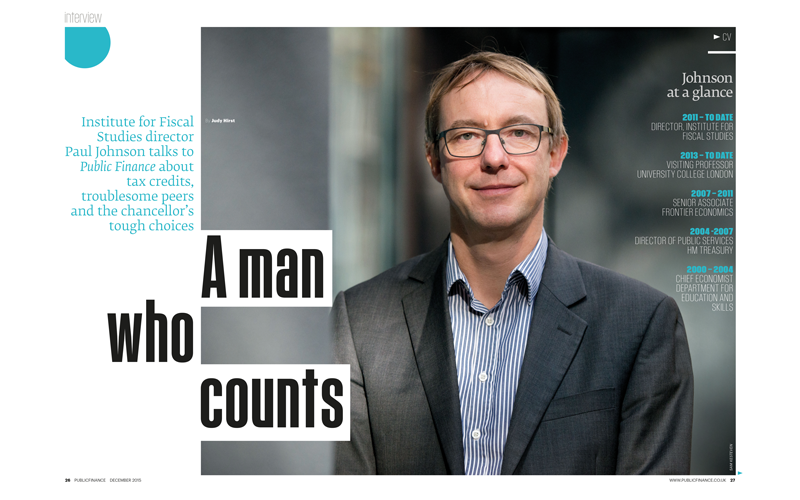
December 2015
‘A man who counts’
Local government finance changing beyond recognition; the chancellor’s tough choices on income tax, NI and VAT levels – and the ‘bonkers’ idea of retaining the triple lock.
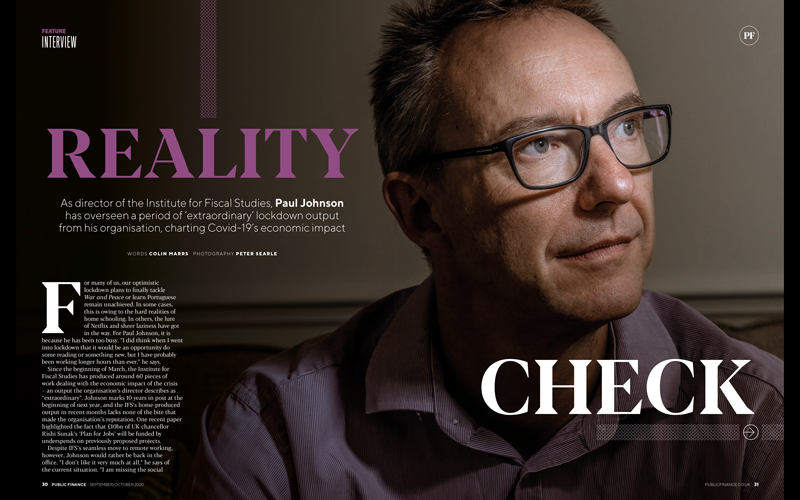
October 2020 ‘Reality check’
Marks 10 years at the IFS.
The inefficiencies of Covid-inspired remote working; the unavoidable trade-offs involved in Brexit – and (familiar) concerns over kicking the social care ‘can’ down the road.