


By Keith Aitken in Edinburgh | 9 January 2012
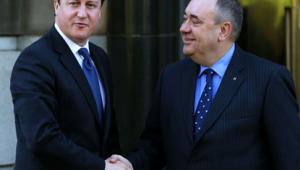
Scotland’s deputy first minister today accused David Cameron of trying to interfere in Scottish affairs, as the British Cabinet met to discuss forcing the pace and the scope of Holyrood’s referendum on independence from the UK.
Over the weekend, the UK prime minister told the BBC that the Scottish National Party government’s delay in setting a date for its promised referendum was harming the country’s economic prospects. ‘We owe the Scottish people something that is fair, legal and decisive,’ he said.
Cameron made clear his own strong support for the Union, but ruled himself out of a leading role in the campaign, saying that it was for Scots to decide.
His intervention prompted an angry response from the SNP. Deputy First Minister Nicola Sturgeon said: ‘This is a blatant attempt to interfere in a decision that is rightly one for the Scottish Government in terms of the timing of the referendum and for the Scottish people in terms of the outcome.’
Two aspects of the referendum plans are in particular dispute. The first is timing: First Minister Alex Salmond has said he intends to call the vote in the second half of the Parliament, and to use the first half to focus on economic recovery.
It is commonly understood that Salmond would like to hold the vote in 2014: the 700th anniversary of Scotland’s defeat of the English at Bannockburn, and a year when both the Commonwealth Games and the Ryder Cup will take place in Scotland.
The second issue is content. Salmond wants to offer a third option besides independence and the devolutionary status quo: a federal ‘devo-plus’ or ‘devo-max’ formula that would give Scotland full fiscal autonomy with an agreed proportion of revenues paid to London for shared functions such as defence and the consular service.
Constitutional matters are reserved to Westminster, but the expectation is that the UK Government will seek to give Holyrood power to hold a referendum, provided it takes place within 18 months, is limited to two-questions and is legally binding. There is also a Labour move in the Lords to extend voting rights to Scots across the UK.
Sturgeon said: ‘The attachment of conditions is what gives the game away – this is about Westminster seeking to interfere.
‘Referendums in the UK are always consultative and advisory – that’s how things are. There is no doubt about the ability of the Scottish Parliament to have a consultative advisory referendum.’
Salmond’s decisive victory in the Scottish elections last May makes it hard for UK politicians to judge how involved to become. Between them, the two UK coalition parties won just 20% of the vote in Scotland, and all three unionist parties have untried new leaders in Scotland.
But London recognises that any perception that it is out to rig the outcome is likely to harden support for independence, which one recent poll put at 38%, with 68% backing devo-max/plus – an outcome that would also satisfy many in the SNP.